Barb's photo challenge this month is to take a self portrait. My preference is to be behind the camera lens only, not in front of it. I do not take photos well...and I am sure that those who see the results will concur. Rather than doing one photo of myself I decided to do three. The first is of me watching college football this past Saturday afternoon.The second is of me watching a NFL game while preparing to drift off to take my Sunday afternoon nap.The third is from earlier this evening when I came in the door after being out with Josh behind the wheel going down I 66. I suspect that dad looked the same when he took my siblings and I out on the 401.


Another election cycle is drawing to an overdue close. In Maryland the ads in the Governor’s race have been bad enough, but they are mild when compared to the Senate campaigns in Maryland and Virginia.
Each campaign uses obscure ancient things to find fault with the other and to make each sound like a fatal flaw. When an opponent changes positions from that which was held earlier in life they call it “flip flopping”. If the person does not change a position they portray the lack of change “arrogance” and as being “out of touch”. They portray the incumbent’s votes, even if the vote had broad bipartisan support, as being rash, lacking courage and wisdom. Positions and quotes are ripped out of their context to be used in way that is contrary to the original meaning.
One ad’s logic I found to be most interesting….it faults the incumbent for voting against stem cell research (a rider on a much larger funding health funding bill said the funds in that legislation could not be used for stem cell research). It then says the incumbent does not want ill people to get well. The ad then calls the incumbent heartless and cold to the needs of the residents of his State. When one tries to correct the record, they are called ungracious and lacking sensitivity and broad shoulders.
We attack our politicians for changing. Hence, we expect them to be immutable, never changing their positions or growing over the years. They are attacked for making a vote on legislation that does not work out as intended. Hence, we expect them to be omniscient, all-knowing and seeing three or seven years into the future with complete clarity and understanding. We hold them accountable for the failings of others associated with them or under their supervision as if they were personally present when the action took place. Hence, we expect them to be somewhat omni-present. We complain when our elected officials are unable to successfully solve with complex issues or situations beyond their control. Hence, we expect them to be somewhat omnipotent, having the ability to have power to solve our problems. And added to that mix, when they are attacked personally, misquoted, their records distorted or maligned in other ways we expect them to suffer quietly. In other words we expect them to be gracious to all, generous to all, quick to forgive and slow to anger, and above all, loving their detractors. We act shocked and fault them for the littlest of character flaws or when they use the wrong word (I am not downplaying those who have brought scandal upon themselves). Hence, we expect our leaders to act and speak perfectly.
At the end of the day we seem to expect our leaders to be mini-gods. We expect them to not like the rest of us who are deeply flawed. Though we expect mini-god like behavior from our leaders, we then attack them when they try to act as if they were mini-gods.
Though the final home football game is in two weeks, officially the marching band season, which started the first week of August, is now over. Late Saturday Josh’s band went to the State’s Marching Band competition. This is the first of two steps necessary for a band must go through to achieve a “State Honor Band” ranking.
The two elements are, the marching band achieving a superior grade, and have the top concert band in the spring achieve a superior grade at Concert Band Festival. Achieving two superior grades is a challenge with less than one out of twenty high schools achieving Honor Band in a given year….only a handful of schools have earned the Honor Band rank for more than four consecutive years.
Oakton has been an Honor Band thirteen in the last sixteen years (they earned their 10th during Jonathan's senior year). Last year was not one of them as its marking as the marching band fell short of the superior grade by one point from one of the five judges.
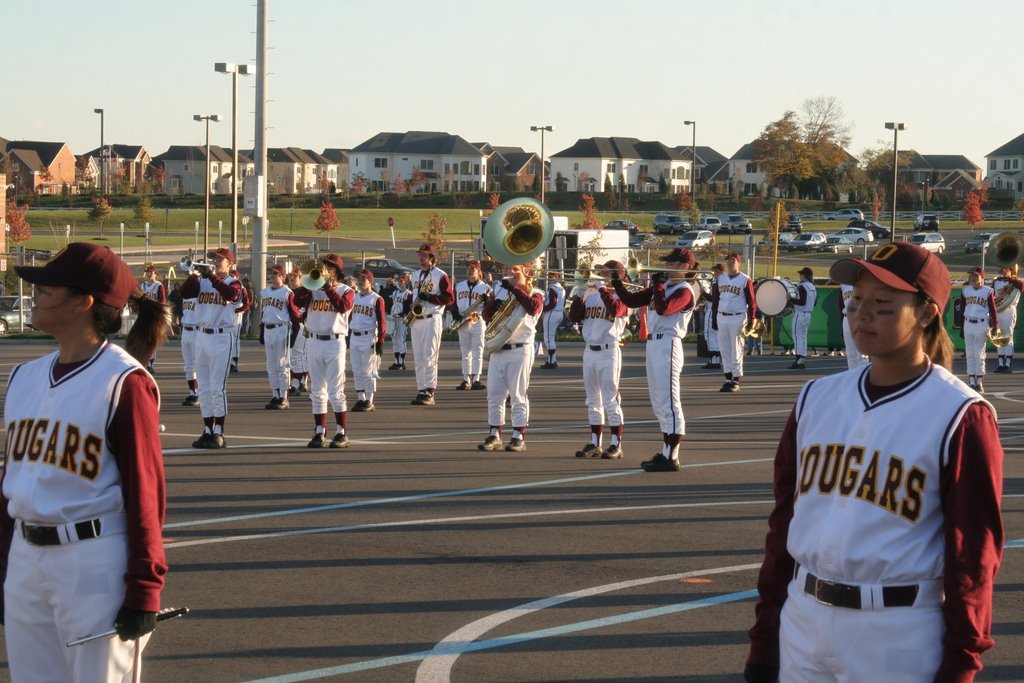
This year Oakton (classed at States as a class 5A band) has taken the first step to return to the Honor Band status by earning early Saturday evening a superior rating. Eight bands achieved that rating in the northern Virginia competition (one 2A, two 3As, three 4As, three 5As….class is by size of the bands). As you will see from the pics, the competition was held on the marching field but on the driver’s education track. As it had rained all day Friday and into the early hours the morning it was felt that the field could not stand up to having thirty-two bands upon it in one day. Sustained winds of 30 mph with gusts up to 45 mph increased the challenge…keeping hats on and for the guard flag drills. Due to the wind the guard had to forgo tossing the flags and drawing out the giant baseball flag (20’ by 40’).
The first pic from early in the show is the front end of the baseball diamond formation. The second pic is of seventh inning stretch where the band and audience sings “Take Me Out To the Ball Game” (Josh is in the five player ensemble in the center of the field).
Yes, in the third pic, that is fireworks going off from the scoreboard following the shooting of a cannon (placed behind the scoreboard). Throughout the performance, the score on the scoreboard changes. Also, on the scoreboard you will see the clock is set to the time of the performance…something that I did for the first competition in Winchester and the back crew continued doing throughout the season. The last pic shows Josh as a backfield conductor as the band moves away from the drum majors at the end of the show. You will also notice due to the wind three parents behind Josh holding the fence.
Other pics from the State Competition should be posted on Oakton’s web page later this week and join the other pics Evie and I have taken throughout the season.




1. Can a batter strike out on foul ball? If you think it is possible, give an example.
Ruling – we often hear announcers talk about a batter striking out on “a foul tip”. In the rules there is no such thing as a foul tip. It is a strike. That said, there is a situation where a batter can strike out on a foul ball, and only one situation….bunting with two strikes and the bunt goes foul.
2. A runner on first (runner 2) gets a great lead and runs hard. He sees that the hit is going to fall between two fielders and keeps running. The runner on second (runner 1) runs part way to make sure that the ball falls in safely before he starts running (just in case he has to return to second if the ball is caught). Runner two passes runner one just before third base and actually steps on third before runner 1. They both make it home safely with runner one crossing the plate before runner 2. What call do you make?
Ruling – runner 1 is called out. A passing is not complete until a base is touched. As third was touched first by the following runner, he has passed runner one and put the first runner in an out position at the end of the play unless they undo the action of the pass. The only way both runners could be safe is if they both go back over third with runner 1 and then runner 2. Then runner 1 crosses third followed by runner 2 to undo the action of the passing.
If there were two outs, runner 2’s score would not count.
3. If while swinging at a pitch, the bat touches the catcher's glove. What call do you make? Does it make a difference if the batter hits a single? Or a double?
Ruling - The batter is awarded first on catcher’s interference. All runners advance if forced.
If the batter hits safely, and all other runners advance safely, it is deemed that there is no interference on the play.
If there are is a runner on base when the batter is interfered with, and the batter hits the ball but either the batter or a runner is out, the offensive manager has the option to accept either the catcher’s interference or the results of the play. If a runner was on third and it was the bottom of the 9th and the batter was out at 1st for the second out while runner scored to give offensive team the lead, the manager should take the results of the play.
4. An outfielder in fair territory positions under a deep fly ball. The outfielder catches the ball just before he hits the fence. As he hits the fence, the ball pops out of the glove and goes over the fence. What is the call?
Ruling - Home run.5. While moving to take a ground ball, the shortstop runs in front of the runner going from second to third (not a forced play). There is no contact, but the runner had to stop before continuing. The runner gets thrown out at third in a bang-bang play. If the runner had not stopped the runner would have easily reached third safely. The runner feels that he was impeded. What is the call? Is the runner safe on interference or is the runner out?
Ruling - If there is no contact, there is no interference. If fielder is moving forward in the process of making a play and there is contact, and the fielder does not make the play, the runner is out for interference. If on the other hand fielder makes contact while not in the immediate and legitimate process of making a play, the fielder has impeded the runner and the umpire places the runner where in the umpire’s judgment the runner would have been safe.
In this case he would be deemed to be safe at third. If he had arrived safe at third and was thrown out at home, and it was not a close play, then the runner is not protected by the fielder’s interference and he is out.
6. Runners on first and third, the pitcher balks as the runner on first goes in motion. The pitcher still pitches the ball, the batter swings, the catcher interferes with the swing and the batter gets thrown out at 1st while runner from third scores and the runner from first ends up on third. What happens?
Ruling - This situation was on my level three certification exam. Here the offensive manager makes the determination. The manager has three options: a) accept the result of the play that gives him a run, b) accept the bulk and have a run with a runner on second, or b) accept the catcher’s interference and have the bases loaded. Option a) is not wise as accepting the bulk gives the team a run without an out. Depending on the score and where you are in the line-up should influence whether to take either b or c as options.