Though the final home football game is in two weeks, officially the marching band season, which started the first week of August, is now over. Late Saturday Josh’s band went to the State’s Marching Band competition. This is the first of two steps necessary for a band must go through to achieve a “State Honor Band” ranking.
The two elements are, the marching band achieving a superior grade, and have the top concert band in the spring achieve a superior grade at Concert Band Festival. Achieving two superior grades is a challenge with less than one out of twenty high schools achieving Honor Band in a given year….only a handful of schools have earned the Honor Band rank for more than four consecutive years.
Oakton has been an Honor Band thirteen in the last sixteen years (they earned their 10th during Jonathan's senior year). Last year was not one of them as its marking as the marching band fell short of the superior grade by one point from one of the five judges.
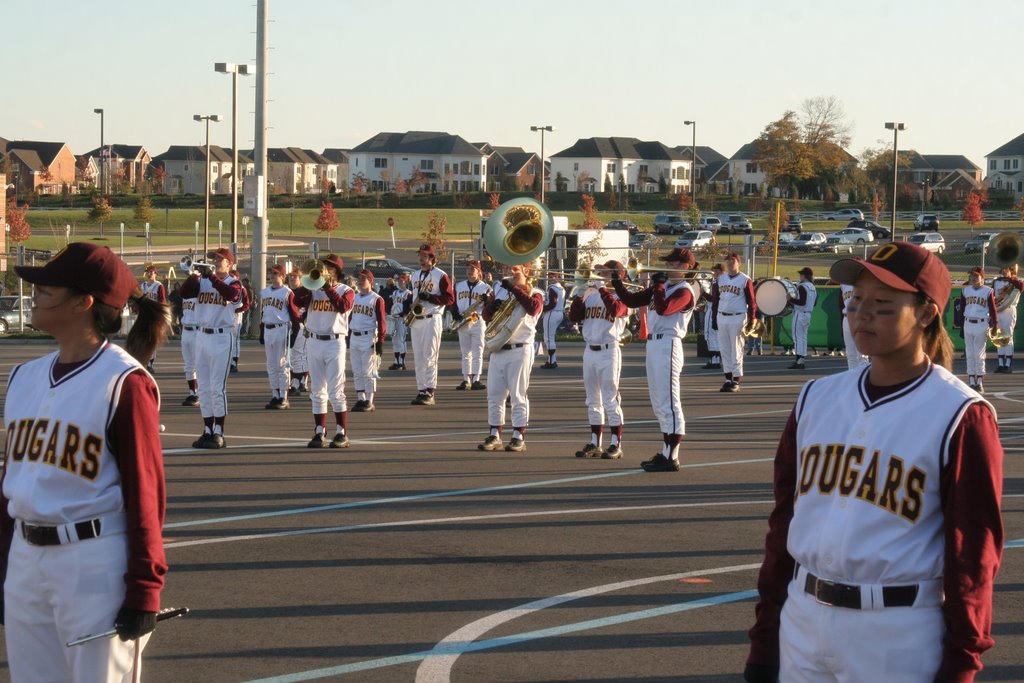
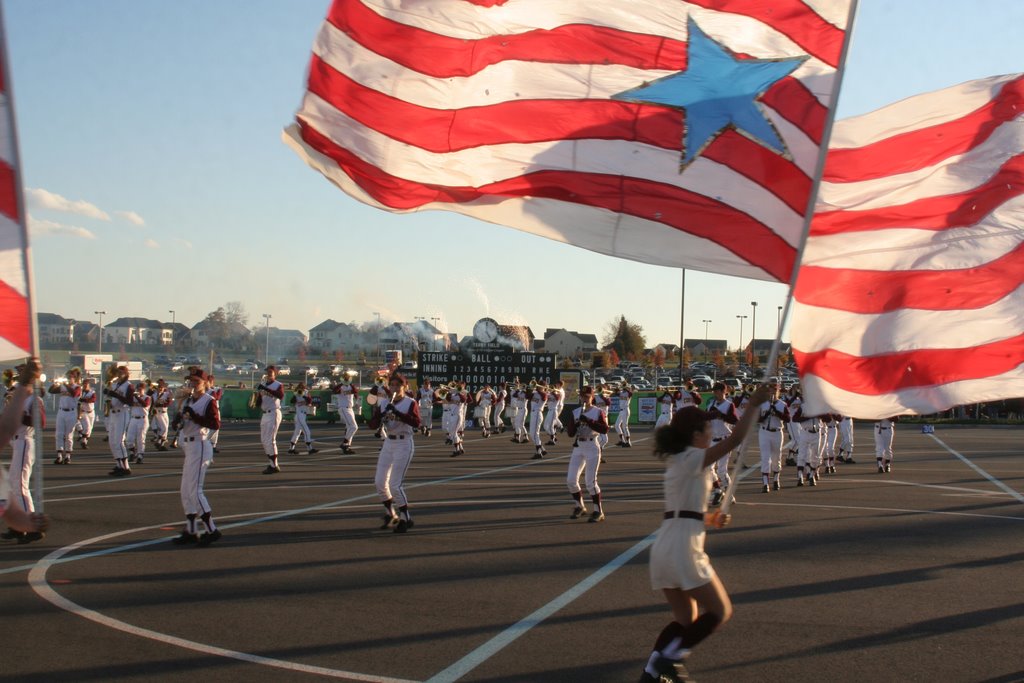
This year Oakton (classed at States as a class 5A band) has taken the first step to return to the Honor Band status by earning early Saturday evening a superior rating. Eight bands achieved that rating in the northern Virginia competition (one 2A, two 3As, three 4As, three 5As….class is by size of the bands). As you will see from the pics, the competition was held on the marching field but on the driver’s education track. As it had rained all day Friday and into the early hours the morning it was felt that the field could not stand up to having thirty-two bands upon it in one day. Sustained winds of 30 mph with gusts up to 45 mph increased the challenge…keeping hats on and for the guard flag drills. Due to the wind the guard had to forgo tossing the flags and drawing out the giant baseball flag (20’ by 40’).
The first pic from early in the show is the front end of the baseball diamond formation. The second pic is of seventh inning stretch where the band and audience sings “Take Me Out To the Ball Game” (Josh is in the five player ensemble in the center of the field).
Yes, in the third pic, that is fireworks going off from the scoreboard following the shooting of a cannon (placed behind the scoreboard). Throughout the performance, the score on the scoreboard changes. Also, on the scoreboard you will see the clock is set to the time of the performance…something that I did for the first competition in Winchester and the back crew continued doing throughout the season. The last pic shows Josh as a backfield conductor as the band moves away from the drum majors at the end of the show. You will also notice due to the wind three parents behind Josh holding the fence.
Other pics from the State Competition should be posted on Oakton’s web page later this week and join the other pics Evie and I have taken throughout the season.



1. Can a batter strike out on foul ball? If you think it is possible, give an example.
Ruling – we often hear announcers talk about a batter striking out on “a foul tip”. In the rules there is no such thing as a foul tip. It is a strike. That said, there is a situation where a batter can strike out on a foul ball, and only one situation….bunting with two strikes and the bunt goes foul.
2. A runner on first (runner 2) gets a great lead and runs hard. He sees that the hit is going to fall between two fielders and keeps running. The runner on second (runner 1) runs part way to make sure that the ball falls in safely before he starts running (just in case he has to return to second if the ball is caught). Runner two passes runner one just before third base and actually steps on third before runner 1. They both make it home safely with runner one crossing the plate before runner 2. What call do you make?
Ruling – runner 1 is called out. A passing is not complete until a base is touched. As third was touched first by the following runner, he has passed runner one and put the first runner in an out position at the end of the play unless they undo the action of the pass. The only way both runners could be safe is if they both go back over third with runner 1 and then runner 2. Then runner 1 crosses third followed by runner 2 to undo the action of the passing.
If there were two outs, runner 2’s score would not count.
3. If while swinging at a pitch, the bat touches the catcher's glove. What call do you make? Does it make a difference if the batter hits a single? Or a double?
Ruling - The batter is awarded first on catcher’s interference. All runners advance if forced.
If the batter hits safely, and all other runners advance safely, it is deemed that there is no interference on the play.
If there are is a runner on base when the batter is interfered with, and the batter hits the ball but either the batter or a runner is out, the offensive manager has the option to accept either the catcher’s interference or the results of the play. If a runner was on third and it was the bottom of the 9th and the batter was out at 1st for the second out while runner scored to give offensive team the lead, the manager should take the results of the play.
4. An outfielder in fair territory positions under a deep fly ball. The outfielder catches the ball just before he hits the fence. As he hits the fence, the ball pops out of the glove and goes over the fence. What is the call?
Ruling - Home run.5. While moving to take a ground ball, the shortstop runs in front of the runner going from second to third (not a forced play). There is no contact, but the runner had to stop before continuing. The runner gets thrown out at third in a bang-bang play. If the runner had not stopped the runner would have easily reached third safely. The runner feels that he was impeded. What is the call? Is the runner safe on interference or is the runner out?
Ruling - If there is no contact, there is no interference. If fielder is moving forward in the process of making a play and there is contact, and the fielder does not make the play, the runner is out for interference. If on the other hand fielder makes contact while not in the immediate and legitimate process of making a play, the fielder has impeded the runner and the umpire places the runner where in the umpire’s judgment the runner would have been safe.
In this case he would be deemed to be safe at third. If he had arrived safe at third and was thrown out at home, and it was not a close play, then the runner is not protected by the fielder’s interference and he is out.
6. Runners on first and third, the pitcher balks as the runner on first goes in motion. The pitcher still pitches the ball, the batter swings, the catcher interferes with the swing and the batter gets thrown out at 1st while runner from third scores and the runner from first ends up on third. What happens?
Ruling - This situation was on my level three certification exam. Here the offensive manager makes the determination. The manager has three options: a) accept the result of the play that gives him a run, b) accept the bulk and have a run with a runner on second, or b) accept the catcher’s interference and have the bases loaded. Option a) is not wise as accepting the bulk gives the team a run without an out. Depending on the score and where you are in the line-up should influence whether to take either b or c as options.
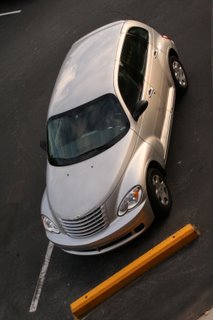
Chevrolet has just introduced the HHR. During my trip to Atlanta I rented a vehicle and was given a brand new HHR….it only had 6 miles on it. As you can see from the pics, the HHR (first pic, white vehicle) look very much like Chrysler’s PT Cruiser (second pic, grey vehicle), a car that I did not like but which has found a following.
Here are my thoughts about the HH2. Be mindful that I did not put it through the rigors that do the testers of Road and Track or the Consumers Report. These are just thoughts of a person who drove one briefly for average driving.
Positives: High head clearance and the seat moved upward to allow one to be at a sofa level in elevation; good cargo space for a small vehicle; outstanding turning radius; an automatically adjusting day/nigh mirror with compass; simple and effective radio design; two glove boxes; back window has its owner wiper and washer; an electronic system via one button on the steering which that tracks mileage, gas consumption, oil condition and engine temperature; window buttons position between the two front seats.
It has adequate pick-up speed. As for padding, the seats are of adequate comfort.
Negatives: A large front blind spot created by the mirror due to the low front window. When going down a hill or around a curve, anything more than 200 yards out to the right goes into a significant blind spot; low front window means that one can not see light changes in the normal seating position if one is the first car in line; hard plastic dash; arm rest between the two front passengers is only 1.5” wide when spacing allows for 2.5”; the arm rests between the two front seats are 1.5 to 2” too short for the average person; the front cup-holders are beneath the arm rests; only one cup-holder for backseat occupants.
Overall, the Chevy HHR is a car with potential that comes up short. Just for the blind spot issues, I give the HHR a failing grade. The vehicle runs nice and may look sharp if you like that look, but if compromises safety, why purchase a vehicle that has a serious forward blind spot for anyone over 5’4”. I am sure others will notice the same and GM apologists will try to explain it all away. I drove it, I will not do so again.
That is my initial thoughts on the HHR. 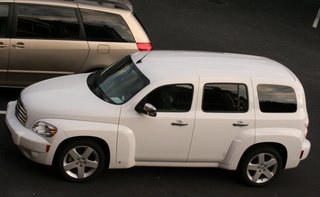
At Oakton High, as at many schools with strong music programs and colleges, band members are placed and seated each year after an audition. Other than section leaders, once seated, each player can issue a challenge to the person in the seat ahead of them. The two players go back through auditions with the winner taking the higher seat.
As Josh was the trombone section leader of Concert Band II and of Jazz II he issued no challenges. He did not receive any challenges to be unseated. Last year as lead trombone of Concert I he received no challenges. Last year in Jazz I he issued a challenge and won the challenge…after winning that challenge he issued another challenge to move up one more chair but the challenge did not go forward as challenges had been suspended.
This year he is in the top band. Symphonic Band plays only college level music. Symphonic seating is completive with challenges taking place throughout the year. When seating was announced, there were a range of challenges across the band. Two challenges took place in the trombone section…4th chair challenging 3rd chair and Stephanie, the 2nd chair challenging Josh. The 5th chair trombone was just happy to have made the band.
Stephanie is an excellent player and co-section of trombones for the marching band. As there was no clear winner after the challenge, Josh remains the section leader. In two weeks she can challenge him again. She also could be challenged by then by the 3rd chair (not likely, but possible). Eventually, challenges for the most part peter out by mid-winter.
The challenges are a variation of the king of the mountain, or Darwin’s survival of the fittest. It keeps better players from being content and pushes them to hone their skills. Whether Josh will remain section leader for a whole season is unknown…if he gets unseated, no doubt he will challenge with an eye to regain the top seat.